Web cookies (also called HTTP cookies, browser cookies, or simply cookies) are small pieces of data that websites store on your device (computer, phone, etc.) through your web browser. They are used to remember information about you and your interactions with the site.
Purpose of Cookies:
Session Management:
Keeping you logged in
Remembering items in a shopping cart
Saving language or theme preferences
Personalization:
Tailoring content or ads based on your previous activity
Tracking & Analytics:
Monitoring browsing behavior for analytics or marketing purposes
Types of Cookies:
Session Cookies:
Temporary; deleted when you close your browser
Used for things like keeping you logged in during a single session
Persistent Cookies:
Stored on your device until they expire or are manually deleted
Used for remembering login credentials, settings, etc.
First-Party Cookies:
Set by the website you're visiting directly
Third-Party Cookies:
Set by other domains (usually advertisers) embedded in the website
Commonly used for tracking across multiple sites
Authentication cookies are a special type of web cookie used to identify and verify a user after they log in to a website or web application.
What They Do:
Once you log in to a site, the server creates an authentication cookie and sends it to your browser. This cookie:
Proves to the website that you're logged in
Prevents you from having to log in again on every page you visit
Can persist across sessions if you select "Remember me"
What's Inside an Authentication Cookie?
Typically, it contains:
A unique session ID (not your actual password)
Optional metadata (e.g., expiration time, security flags)
Analytics cookies are cookies used to collect data about how visitors interact with a website. Their primary purpose is to help website owners understand and improve user experience by analyzing things like:
How users navigate the site
Which pages are most/least visited
How long users stay on each page
What device, browser, or location the user is from
What They Track:
Some examples of data analytics cookies may collect:
Page views and time spent on pages
Click paths (how users move from page to page)
Bounce rate (users who leave without interacting)
User demographics (location, language, device)
Referring websites (how users arrived at the site)
Here’s how you can disable cookies in common browsers:
1. Google Chrome
Open Chrome and click the three vertical dots in the top-right corner.
Go to Settings > Privacy and security > Cookies and other site data.
Choose your preferred option:
Block all cookies (not recommended, can break most websites).
Block third-party cookies (can block ads and tracking cookies).
2. Mozilla Firefox
Open Firefox and click the three horizontal lines in the top-right corner.
Go to Settings > Privacy & Security.
Under the Enhanced Tracking Protection section, choose Strict to block most cookies or Custom to manually choose which cookies to block.
3. Safari
Open Safari and click Safari in the top-left corner of the screen.
Go to Preferences > Privacy.
Check Block all cookies to stop all cookies, or select options to block third-party cookies.
4. Microsoft Edge
Open Edge and click the three horizontal dots in the top-right corner.
Go to Settings > Privacy, search, and services > Cookies and site permissions.
Select your cookie settings from there, including blocking all cookies or blocking third-party cookies.
5. On Mobile (iOS/Android)
For Safari on iOS: Go to Settings > Safari > Privacy & Security > Block All Cookies.
For Chrome on Android: Open the app, tap the three dots, go to Settings > Privacy and security > Cookies.
Be Aware:
Disabling cookies can make your online experience more difficult. Some websites may not load properly, or you may be logged out frequently. Also, certain features may not work as expected.
UConn DMD Election Night Live Social Media Analysis
Tuesday, November 3 at 5:30pm
Join us on Election night from 5:30pm-6:00pm EST for a live broadcast from the UConn SMACC (Social Media Analytics Command Center). Faculty and student researchers will discuss critical election issues, analyze real-time social media trends, and make some predictions. Watch it live on Youtube.
Our Digital Media & Design student analysts have been following the presidential race and related topics on social media and will be monitoring real-time data on election day. With Americans breaking early voting records in key states across the country, will this election prove to have the highest voter turnout in American history? What will we know on election night?
Topics up for discussion include:
Sentiment analysis of both presidential candidates
Swing states such as Florida, Pennsylvania, Michigan, Ohio, Wisconsin, North Carolina, Arizona
Key Senate races in Arizona, South Carolina, Kentucky, and Maine
The Vice Presidential Debate and how one moment can go viral (the fly)
Russian influence and bots in social media
The proliferation of fake news regarding COVID-19
Conversations about white supremacy and militia groups in America
The research team includes Assistant Professor In-Residence John Murphy and DMD students: Ryan Young, Christina McDonnell, and Rosalie Garcia. Associate Professor of Political Science and Director of Middle East Studies, Jeremy Pressman, will also talk about Foreign policy under Trump or Biden during the Election Night broadcast.
Follow us on Twitter @UConnSMACC on and after Election Day to see how social media data provides unique insights beyond traditional polling data. To learn more about the kinds of election-related data we’ve been analyzing, visit: https://smacc.lab.uconn.edu.
Brian Daley joined the Digital Media & Design program in Fall 2017. Prior to becoming a full-time faculty member, Brian served as an adjunct lecturer for several years in the Web Design & Development concentration.
For nearly 20 years, Brian has been creating for web and mobile platforms as a freelancer and a web developer with University Communications at the University of Connecticut. His work includes projects like the UConn homepage and UConn Health, as well as many other high-profile digital marketing campaigns and websites.
Heather Elliott-Famularo is an award-winning filmmaker and artist whose varied research interests include documentary film, fine art installation, photography, and collaborative digital humanities projects. Active across the fields of broadcast television, computer graphics and interactive multimedia, her documentary, Bearing Witness: The Voices of Our Survivors, won the Audience Award for Best Documentary at the Palm Beach International Film Festival and was nominated for an Emmy award by the National Association of Television Arts & Sciences – Lower Great Lakes chapter. She has been awarded over $2 million in external research grants as PI/Co-PI from the NSF, NEH, Ohio Humanities Council, the Connecticut Economic Resource Center, and private foundations. She received a Fulbright-Hays Group Project Abroad Program grant for Walking Witness: Civic Responsibility in the Shadow of the Holocaust, leading a group of educators across Poland, Hungary, and Greece to understand the still lingering impacts of the Holocaust. She has presented, and her work has been published and exhibited, internationally in Canada, Hungary, Italy and Poland as well as at iDMAa and SIGGRAPH, where she has also acted as curator and juror of numerous exhibitions, including SIGGRAPH 2004 Emerging Technologies.
As department head at UConn, Elliott-Famularo is respected for building bridges between the humanities, arts, and sciences. Her most prominent collaborations include the Human Rights Film and Digital Media Initiative with the Gladstein Family Human Rights Institute, STEAM-related projects around art+science communication, creation of a Digital Public History minor, and sports entertainment with UConn Athletics.
‘My whole life I secretly wanted to make video games but was scared. I didn’t think it was something that I was allowed to do because it seemed too fun’
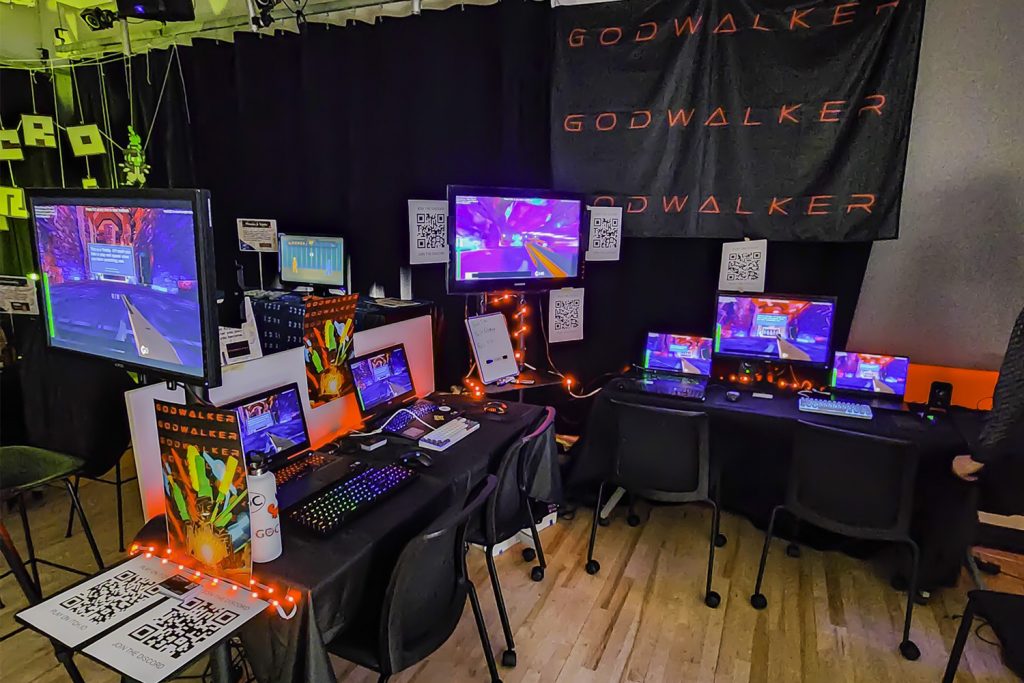
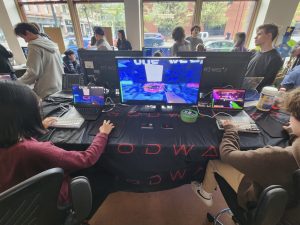
The Godwalker showcase booth at the NYU showcase. (Contributed photo)
Josh Hirshfield was that kid in middle school who’d spend all weekend playing video games.
“I was playing on my parents’ 1997 Dell computer with 128MB of RAM, because that’s what we had at the time. Playing old titles like SimCity 4 or Roller Coaster Tycoon exposed me to the idea of creating digital virtual worlds,” he says. “The one that really blew my mind was Spore by EA. It introduced me to this world of 3D design where you can make buildings and creatures, animals and spaceships all from your computer.”
WhenHirshfield ’21 (SFA)went back as an adult to visit his seventh and eighth grade teachers and told them he nowmakesvideo games, no one was surprised.
“My whole life I secretly wanted to make video games but was scared. I didn’t think it was something that I was allowed to do because it seemed too fun,” he says.
The video game Godwalker is the latest project from Josh Hirshfield ’21 (SFA), who says he always wanted to be a video game designer but didn’t think he was allowed to – because it’s too fun. (Contributed art)
Now, almost every day is fun for the Stamford native who just earned his MFA in game design from NYU, has his own independent studio, is working with theNeag School of Educationto create educational software, and has interviewed for senior-level positions at some of the largest companies in the industry – at 24 years old.
“For a lot of my life, I thought I would do things around video games, like make the art or make the music for video games. It was only once I had a high school class in game development that I realized there was a path for building video games,” he says, explaining that class prompted him to consider colleges with game design programs, which led him to UConn’sDigital Media & Design.
“The idea that I could get a degree where one of the words in the degree is ‘games’ is really amazing and those programs are hard to find,” Hirshfield says. “UConn has one, it was accessible, and my parents loved it when I told them I wanted to make video games. Finding and pursuing a passion really matters to me and my family.”
As an undergrad, Hirshfield loaded his schedule – almost overloading it – with independent studies, one year even acing all his classes and adding 48 credits to his transcript. He says he would pair a class like Interactive Storytelling with an independent study to produce projects that paralleled the lessons learned in class.
Another independent study coupled him with theSchool of Businessto create an interactive training program for the Connecticut Community for Addiction Recovery. That program,The Recovery Files, aims to train recovery coaches in what to say – or not say – by presenting them with interactive sample text messages for a variety of scenarios.
“Most video games are fun. Most are about bringing enrichment to your life. But some tell sad stories just like film or TV,” he says. “And serious games are this idea that by sharing an experience you can perform social action. The idea of The Recovery Files was that you would play it and the serious function of the game was to train and enrich the minds of those who are going to help others.”
Then there are other times when gaming just needs to be about gaming – an escape from reality.
Josh Hirshfield ’21 (SFA) gives a thumbs up while taking a break during RPI GameFest in April. (Contributed photo)
“I get made fun of a lot because I care about social action games and then I go and make the most stereotypical video game ever,” he says of the first-person shooter gameGodwalker, in which the idea is to shoot the bad guys as quickly as possible to gain strength.
“It’s not very long, it’s not very big, but I did make it on my own,” he explains. “I didn’t buy any assets. I didn’t have anyone make anything else. It all came from my computer and my brain, and to me that’s an invaluable piece of work to have. You can present it to someone and say, ‘This is something that I made, and I think it’s really cool.’”
He told people a variation of that in April when he trekked to Troy, New York, to demo Godwalker at Rensselaer Polytechnic Institute’s annual GameFest, an event that draws game designers from throughout the Northeast to compete for aseries of awards – real-life awards, not ones handed out in a game world after virtual play.
“The first game I ever made, Aether, went to RPI GameFest because I just wanted to show it to people and see how they liked it. The judges ended up giving it the award for Best in Game Feel, which is really cool,” he says of the game that was developed mostly during high school and finished at UConn.
The Godwalker table was popular at RPI GameFest in April. (Contributed photo)
“The judges are from throughout the industry, and you get some awesome validation from external sources that aren’t just your friends,” Hirshfield says. “I hate having an ego, but it’s cool that I can say I’m pretty good at the thing I do.”
While he now mulls the question of what comes next, Hirshfield notes that a friend is the person at the New York Times who makes sure games like Wordle and Spelling Bee come out on time every day.
“What does a game designer actually do,” he asks. “Do you think that the New York Times crossword puzzle just pops into existence? We work in the background. A good design is not something you notice.”
The inaugural film festival aims to connect filmmakers, human rights advocates, and community groups with the common goal of sustained, transformational impact
Sona Tatoyan, who’s been in residence at UConn the last two weeks workshopping her multimedia puppetry show “Azad,” holds her great-great-grandfather’s Karagöz puppets. (Contributed photo)
Northeast Human Rights Film Festivalorganizers hope the impact of this week’s three-day festival at UConn extends beyond the theater experience and calls audiences to take action.
An expansion of the Human Rights Film & Digital Media Initiative established in 2020 by the leaders of the Human Rights Institute, Digital Media & Design department, and Dodd Human Rights Impact, the inaugural film festival aims to connect filmmakers, human rights advocates, and community groups with the common goal of sustained, transformational impact.
Festival Co-Director and Donna M. Krenicki Professor for Design and Digital Media Heather Elliott-Famularo, department head for Digital Media & Design, says the ideal outcome of the festival is that people will walk away afterward and feel impassioned to do more, perhaps volunteer for a community effort, lobby politicians, donate to a related organization, or participate in campaigns. The ultimate hope is to inspire and motivate people to translate their passion into action.
Poster for The Territory (Contributed photo)
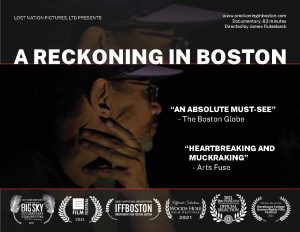
Amongthe festival’s full schedule of free eventsare screenings of:“The Territory”on Friday night, an authentic portrait of an Indigenous community’s fight to protect their ecosystem from illegal deforestation in Brazil; two films on Saturday,“Clarissa’s Battle,”the story of the fight for universal child care and early childhood education for low-income families, and“A Reckoning in Boston,”which highlights the systemic racism and economic inequities in Boston; and“Midnight Traveler”on Sunday, which shares the dangerous trek of an Afghan family as they seek refuge in Europe.
“While the films’ themes may be very different, the issues addressed are things we can all relate to. The films address a wide spectrum of human rights concerns,” says Kathryn Libal, festival co-director and Gladstein Family Human Rights Institute director/Dodd Human Rights Impact interim director. “It’s critical for us to think about what fundamental rights we have as human beings within an increasingly interconnected world.”
Elliott-Famularo explains that the films use a participatory approach to filmmaking, in which the filmmaker engages directly with the subject and reveals their role in the film, instead of using a third-person narration or standing on the sidelines.
Poster for Clarissa’s Battle Growth of a Movement (Contributed photo)
“Participatory documentary filmmaking requires a level of vulnerability by both the filmmaker and the participants in the film, who are often collaborative partners in the filmmaking process rather than passive ‘subjects.’ It also inherently reveals the power of media to invoke real change, because the audience can essentially see the film being made on screen. This happens, for example, when James Rutenbeck, director of ‘A Reckoning in Boston,’ shares that he would make an entirely different film due to the relationships he built with Carl Chandler and Kafi Dixon and when Hassan Fazali directly speaks about both his role as a filmmaker – and an asylum seeker – in ‘Midnight Traveler,’” Elliott-Famularo says.
“For filmmakers committed to impact work, building trust within communities is essential. Each of the films we selected shows how collaboration and a commitment to social change elevates a film from a documentation of events to an opportunity for continued advocacy work,” says Erica Laplante ’22 Ph.D., festival co-organizer and postdoctoral research associate at the Gladstein Family Human Rights Institute. “By pairing these films with impact events at the festival, we can further inspire action beyond the screen, through community partnerships and relationships.”
Poster for A Reckoning in Boston (Contributed photo)
Each of the four award-winning films will be accompanied by a unique impact event, featuring the filmmaker and others connected to the project or the topic. For example, following the screening of “A Reckoning in Boston,” there will be a dinner and Encounters Dialogue, during which the community will engage in small group discussions around the issues of housing and racial justice raised in the film.
In addition to the four invited films, the festival concludes with a Sunday evening performance of the multimedia puppetry project,“Azad,”recipient of the inaugural UConn Global Affairs Digital Media Residency awarded byGlobal Affairs, Dodd Human Rights Impact, and the Levant Foundation.
For the residency, “Azad” writer/performer Sona Tatoyan and her crew has spent two weeks at UConn workshopping the show that uses her great-great-grandfather’s handmade Karagöz puppets to tell the story of her family, the Armenian genocide, and contemporary Aleppo. “Azad” will be performed at theBallard Institute and Museum of Puppetry, followed by a closing reception for the festival.
Poster for Midnight Traveler (Contributed photo)
“Building on UConn’s 25-year history of human rights work and our new DMD major in film production, we have the possibility to make UConn a national leader in this kind of impact work for film and digital media,” Elliott-Famularo says. “The Northeast Human Rights Film Festival is the next step to realizing that goal.”
Find a full list of events at theNortheast Human Rights Film Festival website. Tickets are free and open to the public but must be reserved viaTicketLeap. The festival is presented by theSchool of Fine Artsand the Gladstein Family Human Rights Institute, with generous philanthropic support from NICABM, the National Institute for the Clinical Application of Behavioral Medicine.
On-campus exhibitions showcase creativity and talent of graduating students
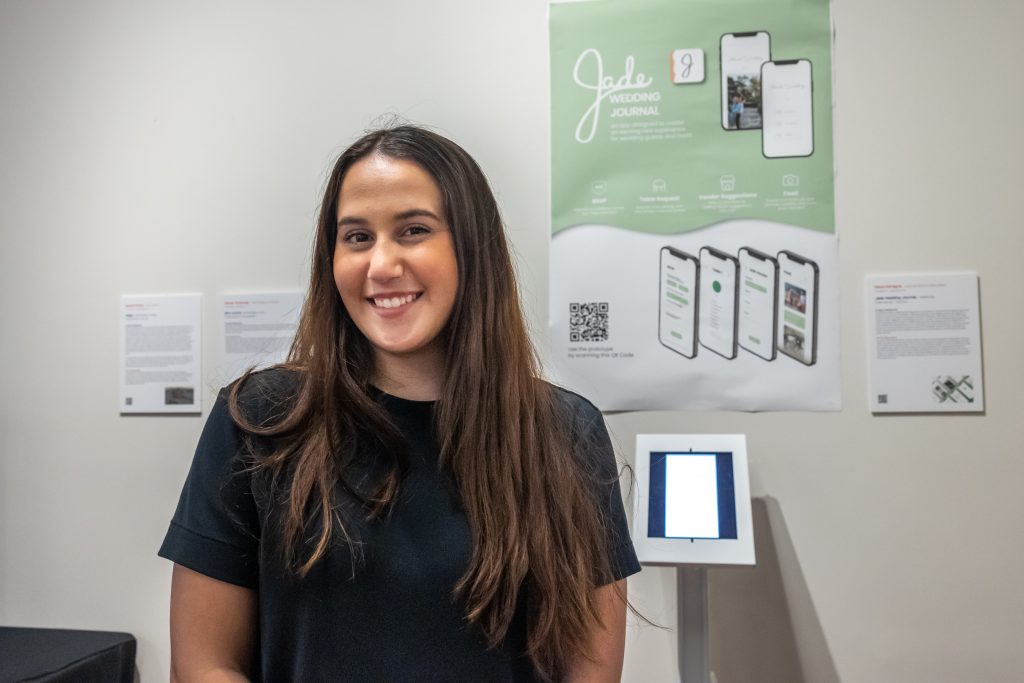
Senior digital media design student Giana Adragna poses for a photo in front of her project on display in the digital media and design program’s “Limitless” BFA senior exhibition in the Jorgensen Center for the Performing Arts’ gallery on April 13, 2023. (Sydney Herdle/UConn Photo)
Years beyond their middle and high school careers – in one case by nearly two decades – and they’re still listening to their teachers.
Kelsey Tynik ’12 (SFA), ’23 MFA says she often draws on skills gained from her middle school home economics teacher, and Giana Adragna ’23 (SFA) points to high school graphic and web design classes as strong influences in her work today.
In the backstory to her latest project, Lexy Vecchio ’23 MFA mentions the teacher, not even from her own school, who came to her aid when she was at her most vulnerable, and Zaire Diaz ’23 (SFA) smiles broadly when she recalls that a high school teacher bestowed on her the nickname DRC, a happy moment in otherwise challenging teenage years.
As graduating students fromDigital Media & Designand theArt and Art History department, each with work on display in three on-campus exhibitions this month, these four might have produced vastly different final projects, but they’re connected – like so many who’ve drawn on previous experiences for inspiration – to their formative pasts.
Playtime as work time
With an undergraduate degree in illustration and art history from UConn, Tynik for many years worked in New York City as a window decorator for a contemporary fashion brand. Seeking a break, she left that job to nanny young children, putting her in the position of watching kids at play and considering how that might look for her.
“I noticed with the kids that their version of play is fun, light, and fearless. They’ll try anything,” she says. “But there’s a system to their play that’s structured yet freeing at the same time.”
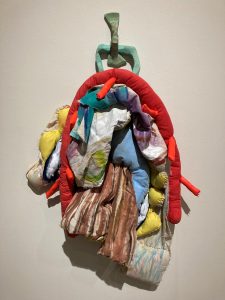
Kelsey Tynik ’12 (SFA), ’23 MFA created the wall sculpture “And cry at the same time when a capering circus clown approaches,” on display at the William Benton Museum of Art until May 7. (Kimberly Phillips / UConn Photo)
As she reconnected to her painting roots, Tynik says she longed to “pluck my work off the wall and break the frame.” That’s when she started to play, taking painted canvas off the stretcher and sewing it into shapes large and small to create 3D wall paintings, like “And cry at the same time when a capering circus clown approaches,” which is on display at the William Benton Museum of Art.
She says she uses Stephen King novels – she’s a fan of horror novels and their own playful structure – as inspiration not just for her work, but also the titles for many of her pieces. In the case of “Capering Clown,” it looks like the remnants of a mischievous character that’s sucked itself into a rainbow of color.
“You know you want to get closer, but you don’t want to get too close in a way,” Tynik says, describing her work. “I like that boundary. It’s tricky when a lot of your work looks fun and friendly, because it is that, but it’s also important to have a boundary between the fun and the viewer. My goal is for people to say, ‘I want to touch it, but I don’t think I should.’”
Tynik also includes carved wood in her pieces, which means she built for herself not just a sewing area but also an enclosed grinding booth with a dust removal system in her work studio.
“It’s wild actually, and I feel like so much has come back to me that feels so familiar,” she says of the skills she gained early on in school. “Habits that I learned as a child, they’ve come back up in a professional sense.”
A little help to plan the big day
When everyone in Adragna’s extended family gets together, she says they total about 50 members, that’s including 17 first cousins, their spouses, and their children. Together, they comprise a large Italian family that likes to celebrate good times, oftentimes dancing the night away.
“We have a wedding almost every year,” Adragna says. “Even if we’re not in a wedding, we’re there for all the events. We love weddings in my family. We go all out.”
As Adragna set to designing an undergraduate DMD project that demonstrates her mastery of web and interactive media, she says she thought about her role as co-maid of honor in her sister’s upcoming nuptials – she’s sharing the job with her other sister – and her place in the wedding parties of seven previous ceremonies.
She also noted that her cousin is marrying this August and is in the throes of planning, so why not design an app that would be meaningful, helpful, relatable, and tied to the very thing in which her family has expertise.
“Jade Wedding Journal,” on display in the Jorgensen Gallery, allows wedding guests to participate in the planning process, differing it from the legions of other apps that help brides and grooms check off items on their to-do lists.
The app allows guests to RSVP, post pictures and updates on a feed, and even make vendor recommendations to the hosts – an idea that came from Adragna’s mom. But its biggest asset might just be guests’ ability to request a specific table and see the table seating arrangement.
“We had a second cousin who had a wedding last year and we didn’t know until we got there if we’d be sitting together as an immediate family. It would have been nice to have that verification beforehand,” she says.
The feature also would be helpful if a guest is a friend from high school, who might not know many family members and who would like to see whether other friends from high school are at their table, Adragna says, explaining that she’s always been a savvy planner and wanted her project to have the ability to relieve the stress of a host who might not be.
“Jade, the stone, means growth and prosperity and new beginnings,” she says of the app’s name. “Green is also a color of growth and the earthtones really spoke to me with the romance of it all. With the name and the color scheme, I really wanted them to be something that’s very meaningful.”
Experiencing PTSD through gaming
Vecchio used to get panic attacks in school and suffered from emetophobia, or the fear of vomiting, that was so severe, she says, if a fellow student threw up in a bathroom, she wouldn’t talk to the person for a week or ever again use those facilities.
Years of misdiagnoses plagued much of her later childhood, she says, and only in her older teenage years did doctors connect the behavioral issues to PTSD that resulted from a skiing accident she had when she was 11 and broke her hip after attempting a maneuver she’d seen some snowboarders do.
Lexy Vecchio ’23 MFA created the interactive “Here There Be Bears,” on display at the William Benton Museum of Art until May 7. (Kimberly Phillips / UConn Photo)
She landed the trick and had only 20 feet to stop before going over a cliff, she recalls, explaining that in the process of stopping she snapped her femur in half, missing her femoral artery by a centimeter, and blacked out off the trail in an isolated area.
“I don’t know exactly how long I was on the mountain. From what I understand, it was probably two hours since I’d only done one ski run. There’s a lot of time dilation I really don’t remember, but I was calling for help for so long,” she says, explaining she didn’t even know she was hurt until she tried to stand.
A child about her age eventually heard her calls, and they sought their teacher for help and later the ski patrol. Vecchio was in a wheelchair for three months and on crutches another three, yet everyone expected that given the presumed resiliency of an 11-year-old, she’d bounce back.
Then entered her behavioral issues.
Her therapist helped her discover the panic attacks were triggered by situations that threatened isolation, she explains, and the emetophobia likely resulted because over those two hours on the mountain certain bodily functions probably started to shut down along the vagus nerve, causing severe stomach pain that she never consciously felt thanks to the trauma.
Now as a DMD graduate student looking for a final project, she knew she wanted to produce an embodied experience geared toward those with a disability, Vecchio says. When an initial idea was thwarted during pandemic shutdowns, she turned to personal experience.
“Here There Be Bears” is an escape-room style, first-person video game on display at the Benton that’s shown mostly in flashback and traps the player in a cave with a bear.
“One of the reasons we chose a cave is because of its isolation factor,” she says. “You’re isolated, alone, mimicking when I was 11. Cellphones were not a thing then, so there was no way to call for help and in a cave cellphones don’t work.”
Vecchio says she wanted to use an accident-based trauma because it’s an isolated event, and most of the population won’t experience PTSD from an accident like the one portrayed – getting trapped in a cave with a bear.
“In the game, you are not a sexual assault victim or a combat veteran, both of which comprise the majority of those with PTSD,” she says, noting that despite PTSD being widely known about people don’t really understand it.
“It’s a misconception that people who haven’t seen combat can’t really get PTSD,” she says, “and PTSD is so often used as a joke, like when people say, ‘I was triggered by that.’ Those misconceptions persist so people don’t understand what PTSD means or how it manifests in people who aren’t your stereotypical post-traumatic stress survivor.”
Changing the past by drawing it
Diaz describes herself as always being artsy, but she didn’t get to study art until coming to UConn.
She attended a high school that centered on nursing, which imprinted the importance of giving blood and knowing CPR, she says, but didn’t give her much in the way of art lessons, save a health teacher who allowed Diaz to draw, label, and describe the function of the heart instead of taking a multiple-choice test.
Another teacher nicknamed her DRC, because the country Zaire is now known as the Democratic Republic of the Congo.
Home is where she got to create characters – how they look, their backstories, their families – and put them in more positive situations than she was experiencing at school, where not only was she studying a field outside her interest, but she also was navigating her gender identity.
Zaire Diaz ’23 (SFA) created the graphic novel “A Confession In March” on display in the Art Building until April 28. (Kimberly Phillips / UConn Photo).
“When I came out as nonbinary and demisexual, I tried to tell a teacher or two who I trusted, but they kind of shut it down and weren’t really accepting of my coming out,” Diaz says. “Because of that I shut myself out and stayed in the closet. Growing up, kids talked about boys and girls and dating, and for me I didn’t feel any of this. People made it seem like I was the strange one because I wasn’t thinking about being intimate or dating.”
The characters she created, “I used them to cope and illustrate things that I wished people would do or how I hoped people would have reacted when I came out because it wasn’t really great, unfortunately,” she adds.
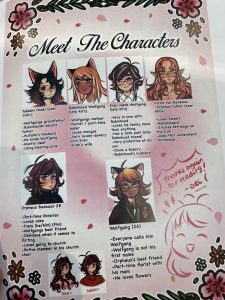
Diaz says the purpose of “A Confession In March,” her undergraduate graphic novel that’s on display in the Art Building, is to give those who are still figuring out their identity a way to feel safe.
“In the story, the main character, Wolfgang, is starting to develop feelings for his best friend. He’s never felt emotions toward other people before that were outside of being platonic and he’s like, ‘Oh, my goodness, what is this?’ I used Wolfgang as a lens of what I went through,” Diaz says, reinforcing that the purpose of the story is for “people to realize they’re valid, whether they’re straight, gay, bi, demi, ace, like I am.”
In a way, she might very well be saving a life, in a same-but-different-way as a nurse.
“I always want my art to be a place where someone feels comfortable and valid, because I never felt that and I want people to feel that. When you don’t have support, you feel alone. I always, especially through my art, want someone to look at it and say, ‘Someone’s out there for me.’”
In spring 2022, UConn’s department of Digital Media & Design hosted the 2022 BFA Senior Exhibition: Resilience, in the Jorgensen Gallery of the Jorgensen Center for the Performing Arts, which featured the work of 25 senior UConn DMD Bachelor of Fine Arts students from the Storrs and Stamford campuses. Exhibited artworks range from animations to documentary films to interactive works, including games. The title Resilience reflected the challenges and experiences of the exhibiting artists.
Ten students received awards for their senior projects. Eight months have now passed since graduation. The department checked in with three of the award winners to find out, “Where are they now?”
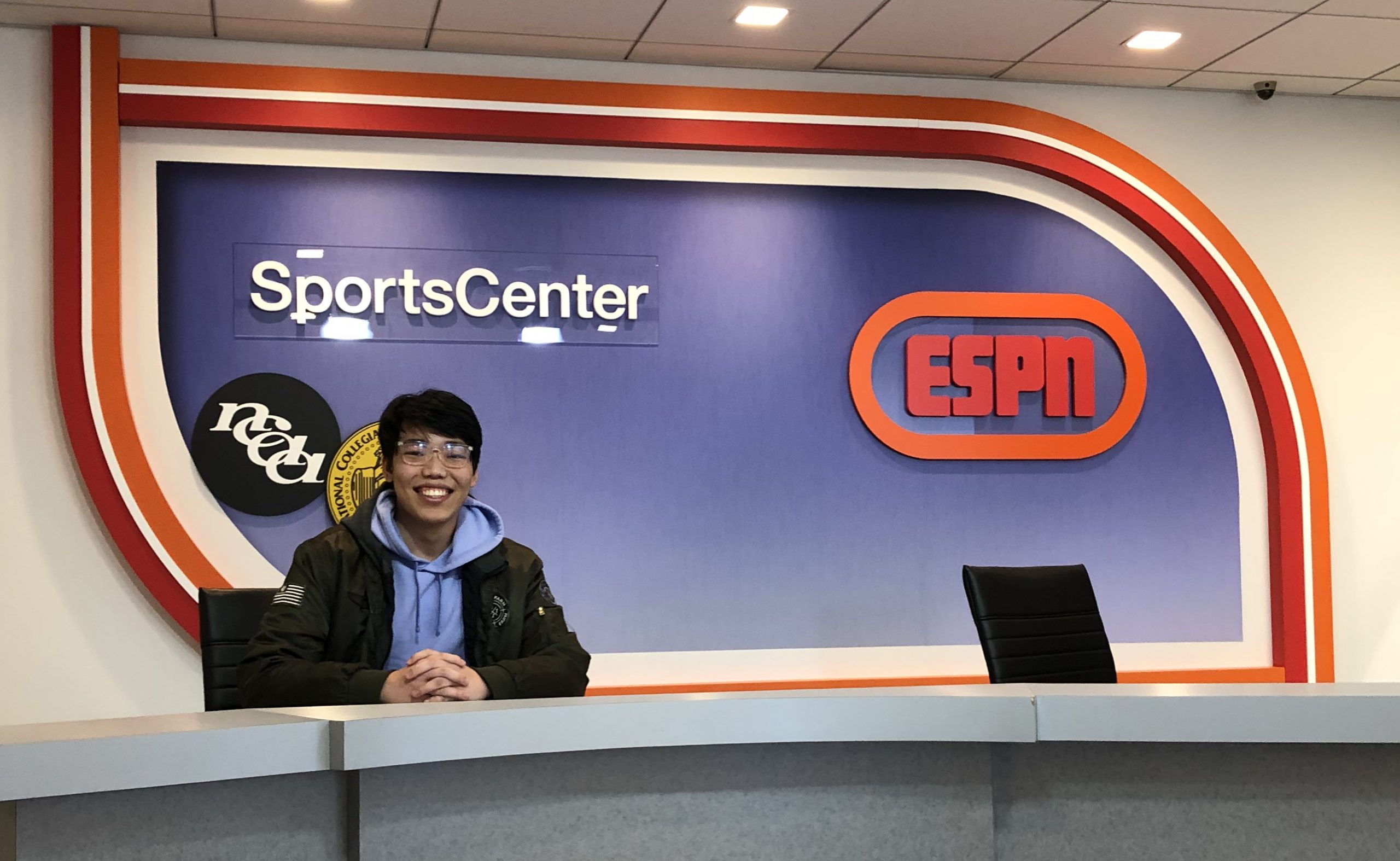
Chaofan Yu smiles as he sits at the Sports Center desk at his new employer, ESPN. (Courtesy of C. Yu).
Chaofan Yu, originally from Jinan, China was awarded an “Outstanding Achievement in Interaction Design” for his mobile app, Vista. It also won the “Gold Award for Student Brand Identity” at the 46th Connecticut Art Directors Club Awards Show.
Chaofan was recently hired as a Real-Time Graphics Developer at ESPN. He believes that the flexibility of UConn’s Digital Media & Design curriculum allowed him to curate from a diverse set of skills beyond traditional graphic design. ESPN uses a variety of software – Cinema 4D, After Effects, and Illustrator, which are all taught in DMD classes that Chaofan took.
“I am the person who creates the graphics and alters the animation at the last minute before they go on air. It’s a high-pressure position,” Chaofan said.
Although he was in the motion design and animation concentration, he also took web design, animation, and illustration classes. For his senior project, Chaofan decided to design a mobile app instead of an animation.
The small class sizes in DMD allowed him to foster close relationships with his professors. Chaofan selected motion design and animation professor, Heejoo Kim, as his faculty advisor for “Vista.”Professor Kim was an extremely supportive mentor during his senior project and a previous independent study.
“As a sophomore, I wanted to create an experimental 2D/3D hybrid animation, something that was way beyond my expectations. She was always encouraging, and it was amazing to meet with her every two weeks about my independent study. Her passion for design helped me set my career goals,” Chaofan shared.
As an animator and web designer, Chaofan produced a plethora of high-quality work for his portfolio during his time at UConn. He also had a range of experiences, as a marketing intern in the Center for Career Development, at UCTV, and as an Associate News Designer at the Daily Campus. And he developed billboard designs for DMD’s 2022 recruitment campaign.
Six months later, he got his dream job at ESPN, the major sports entertainment company in Bristol, CT.
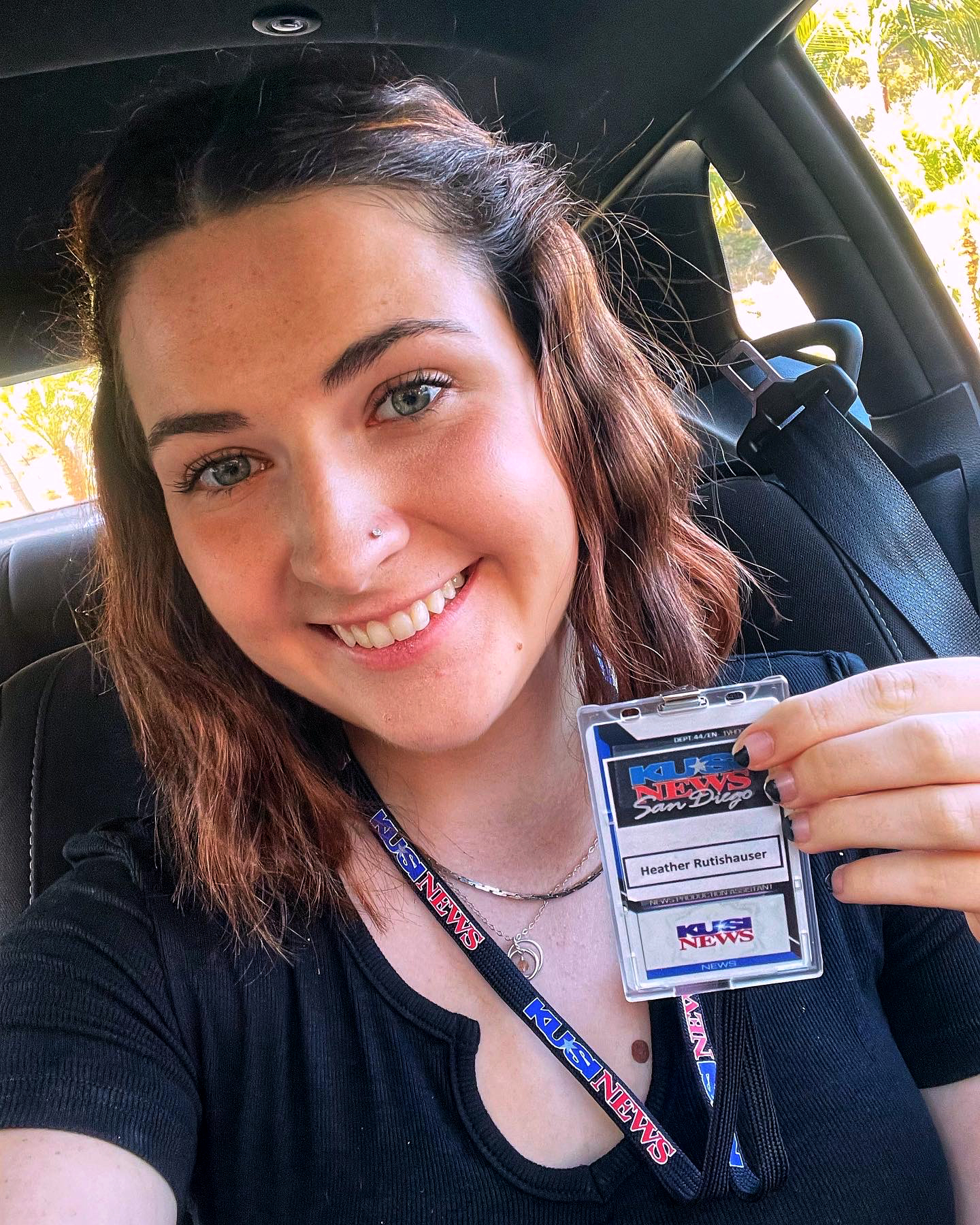
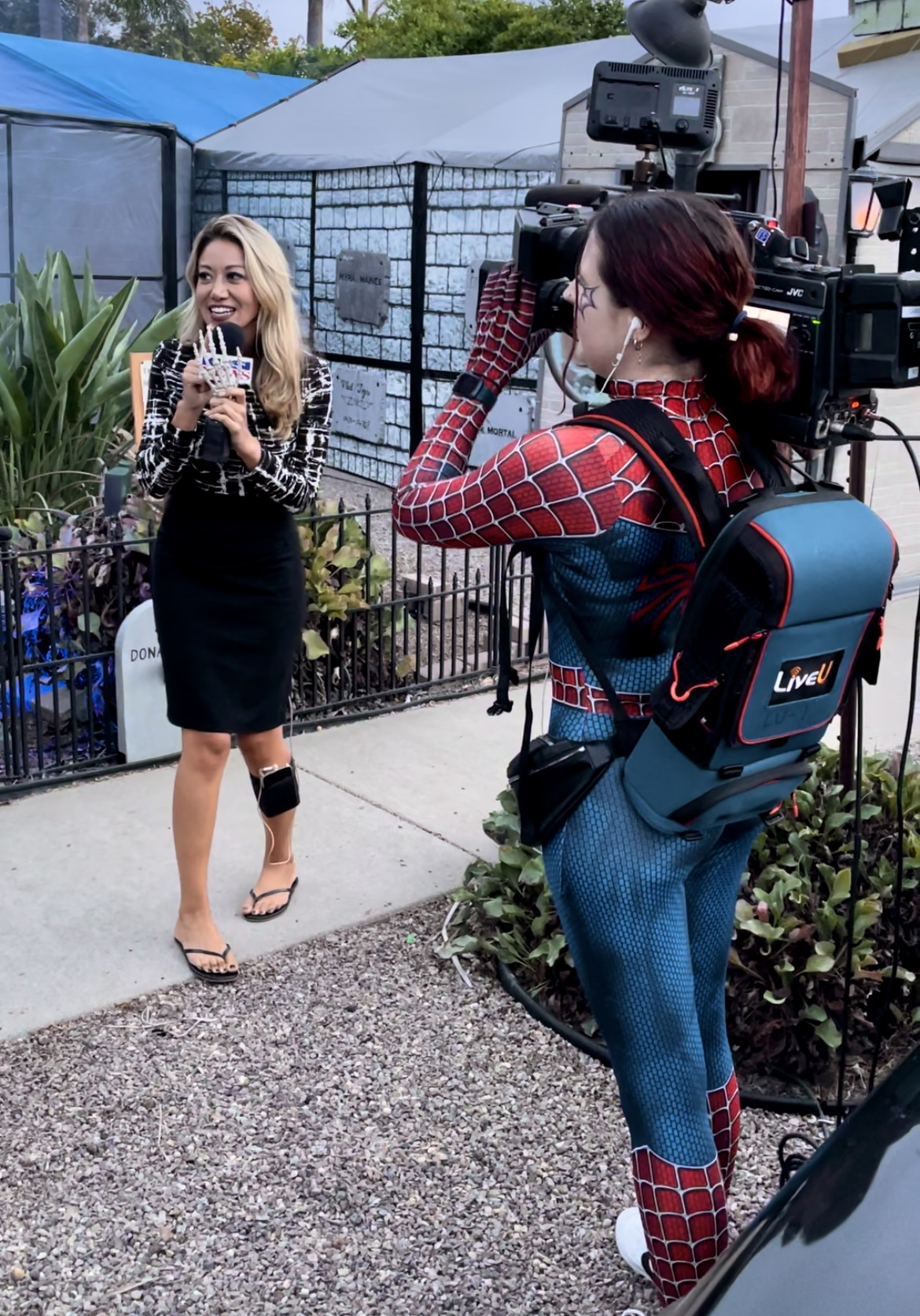
Heather Rutishauser landed a job at KUSI San Diego after graduation. (Courtesy of H. Rutishauser).
Heather Rutishauser of Monroe, N.Y., was awarded an “Outstanding Achievement in Documentary Film” for her short, Floating to Freedom, which combined archival footage, animations and interviews to tell the story of her uncle, Hai Do, a Vietnamese refugee and current photojournalist, and his struggle to escape Vietnam during the war. After graduation, Rutishauser was hired as a news photographer at local news station KUSI-TV in San Diego.
“I’ll get assignments and go out to film B-roll. Sometimes I’m also recording sound and actually have to interview the people on weekends, because they don’t have reporters on the weekends. Or I go out with a reporter and record them on location and then edit the show. Another big thing I’ve done on the weekends is NAT packages, which means natural sound. That’s when I go out on my own to record an event, without a reporter,” Heather said.
Heather Rutishauser had an assignment filming on location for KUSI San Diego on Halloween. (Courtesy of H. Rutishauser).
With the B.F.A. curriculum in Digital Media & Design – Motion Design & Animation concentration, she earned a solid foundation of animation skills which led to freelance work in motion graphics.
She also took DMD film courses in editing, cinematography and documentary production. Her interest in documentary was supplemented by a minor in sociology and a background in drawing, which prepared her to incorporate animation in her film projects.
“UConn definitely prepared me technically, in terms of camera and editing experience, in order to get this job. I was really surprised when they first took me on, because I have almost no explicit journalism experience. But after being in this job for over a month, I realized that a solid technical foundation made me easily adaptable to different types of positions,” Heather said. “Creating documentaries has helped tremendously as well, because the concept of building a story based in truth is everything in journalism. Now, I use those skills to tell different stories in careful and considerate ways.”
Six months after graduation, her experiences in UConn’s Digital Media & Design program led Heather to her current job as a photojournalist at KUSI, an independent television station in San Diego, CA.
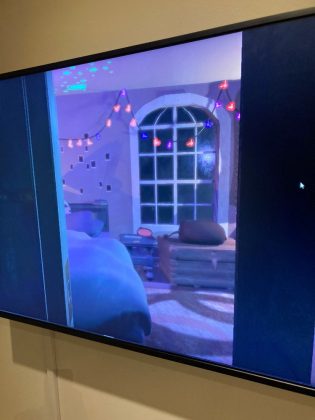
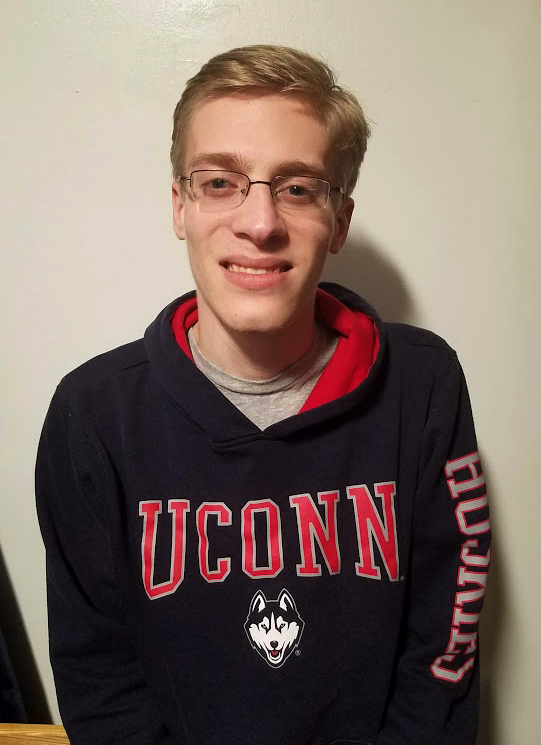
Jon Larsen, from Stratford, CT, was awarded an “Outstanding Achievement in Game Design” for his video game, Paint Knight.
Paint Knight focuses on a courtly painter who awakes from his slumber to find the world drained of color. The project takes inspiration from Jon’s work in drawing cartoon parodies of popular video game characters and platformers like Paper Mario.
Immediately after graduation, Jon was hired as a part-time graphic design artist at Tech Learning Network, creating lower thirds and transitions for educational YouTube videos. His boss was impressed by his Photoshop skills, which is something that Jon credits to DMD’s curriculum.
At UConn, Jon was a B.F.A. student in the game design concentration. As part of his education in game and UI design, he was taught to make his work accessible to a wide audience. This included being selected and certified, as a UConn student, as a specialist in accessible player experiences through a Dell Education Grant in 2021. In DMD’s client-facing Agency course Jon served as the primary visual designer on a team that made a fun hybrid animation for “The Small World Initiative.”
“I gained experience with Adobe software in DMD. For my job at Tech Learning Network, I used Photoshop a lot. My boss joked about how I was one of the few employees that knows how to use the software effectively,” Jon said. “The motion graphics, design lab, and the UI classes helped me to get a solid footing in Photoshop and After Effects.”
The DMD program’s emphasis on storytelling, technical skills, and aesthetics helps students build strong portfolios. The wide variety of coursework and flexible curriculum prepares students for future careers in diverse industries, including entertainment, news, design and advertising. And the world-class faculty offer mentorship and great opportunities for students.
Additional award winners from the 2022 BFA Senior Exhibition: Resilience are: Megan Du Plessis (South Windsor, Conn.) was also awarded “Outstanding Achievement in Documentary Film” for “Invisible Ties.” Lauren Platt (Skillman, N.J.) won “Outstanding Achievement in 3D Animation” for “Starry-eyed.” “Outstanding Achievement in Motion Design” winners were EJ McCabe (Bridgewater, Mass.) for “Cats vs Robots” and Paula Guerrero (Stamford, Conn.) for “Gatcha!” Eric Laputka (Bridgewater, N.J.) also won “Outstanding Achievement in Game Design” for his 3D video game “Pizza Time.” Cara Tracey (Darien, Conn.) also was awarded “Outstanding Achievement in Interaction Design,” for her mobile app, ”PeakBag.” The final award was given to Nicole Mata (Tolland, CT) for “Outstanding Achievement in Creative Visual Design” for her 2D animation, “How to Conserve Bread.”
UConn’s first integrative studies student bridges passion for art, engineering in research and life
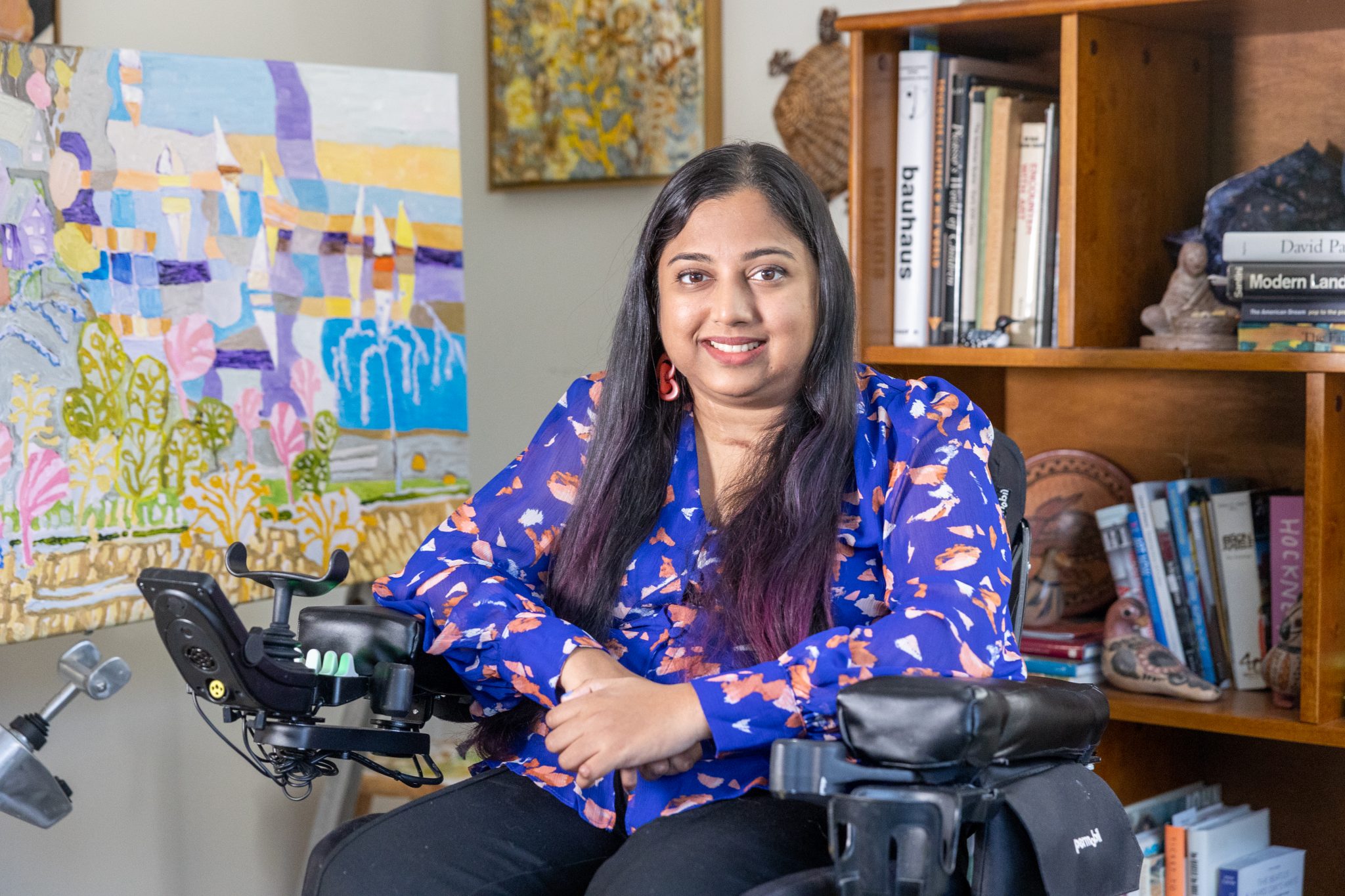
Arpita Kurdekar, an integrated studies Ph.D. candidate in the School of Fine Arts, the Neag School of Education, and the School of Engineering at UConn, poses for a photo among her artwork displayed in her apartment in Storrs on Jan. 12, 2023. (Sydney Herdle/UConn Photo)
Arpita Kurdekar’s story doesn’t start at the point she came to the United States, or when she got her dream job as an engineer, or when she pivoted to graduate studies at UConn. It doesn’t even begin when, as a young woman just starting out, a tree limb fell on her, rendering Kurdekar paralyzed from the chest down.
Her story begins long before all of that, when she was a young girl in India, and first picked up a paintbrush. It was a childhood hobby stoked by two artist parents and encouraged by accolades and a few awards for her work.
Growing up, Kurdekar was caught between an affinity for art and a passion for math and science, the latter winning out educationally and professionally when she pushed painting aside and sought to design bridges as masterful as her favorite, the Brooklyn Bridge.
Never did she think the bridge that would become her greatest accomplishment to date would be the one that marries engineering and art, bringing travelers to a place that merges the two – if only virtually.
‘My life changed in just a moment’
Kurdekar earned a master’s degree in engineering from the University at Buffalo in 2015 after completing her undergraduate degree in India and working a few years at a structural engineering firm there. She came to the U.S. for the opportunity of advanced education and the hope for a professional license not long thereafter.
While at Buffalo, an internship at the New Hampshire Department of Transportation provided a conduit to a full-time position in the Granite State at GM2 Associates, where she focused on structural design calculations for projects in Connecticut, New Hampshire, and Vermont.
She says she enjoyed the work, suiting up in a safety vest and headlamp out in the field, ascending into the underbelly of structures for visual inspections, and sometimes walking through construction sites as workers laid the steel girders that help give a bridge its strength.
“One day, about seven months after I started at GM2, I went home after work and planned to go to the gym. As I walked down the driveway, a neighbor’s tree fell on me and immediately I was paralyzed with a spinal cord injury,” she says. “My life changed in just a moment.”
Kurdekar says she lay on the ground calling for help for an hour because she was in a location that neighbors couldn’t readily see. Eventually her roommate came home, and Kurdekar says she remembers being found. She then lost consciousness.
Girish and Vandana Kurdekar traveled from India as quickly as possible to sit by their daughter’s bedside, and today provide her around-the-clock care. Her first memory after the accident was waking to them in the hospital.
“It was a very difficult time,” Kurdekar says of those early days of recovery. “I was on a ventilator, so it has been a long recovery journey. I had to learn to breathe on my own again, how to talk, how to eat, and how to move what parts of my body I could. It has been a very, very long and difficult six years.”
Those early days of rehab at Spaulding Rehabilitation Hospital Boston were centered on regaining the most basic of life skills. Once Kurdekar moved to Crotched Mountain Rehabilitation Center in Greenfield, New Hampshire, a therapist suggested she tap not just into the muscle memory of the art from her youth but also the peace it gave her.
At first, Kurdekar says the only movement she had was shrugging her shoulders. Then, with the aid of a splint, she learned to hold a paintbrush. Eventually, she wrote her name, and later she painted flowers.
“I remember those sunflowers,” she says with a giggle. “They didn’t look like sunflowers – only my therapist and I knew they were sunflowers. Still, art has been an outlet of joy for me to fight depression and feel happy again. It gives me a lot of rest and peace.”
As she awakened to the value of art in her life, Kurdekar returned to work at GM2 for a few months before assessing her professional future and recognizing academia was the place she wanted to be.
GM2 President and CEO Manish K. Gupta ’98 MS, ’01 Ph.D. had become a mentor to Kurdekar and spoke fondly of his time at UConn. At his urging, she applied.
Arpita Kurdekar, an integrated studies Ph.D. candidate in the School of Fine Arts, Neag School of Education, and the School of Engineering at UConn, works on a painting in her apartment on Jan. 12, 2023. Kurdekar uses a wrap on her hand to help hold her paintbrushes, and one of her engineering friends made the easel she works on adaptable so she can adjust the position of the canvases on it with ease using a joystick. (Sydney Herdle/UConn Photo)
Teaching with VR Technology
Accepted into theSchool of Engineering Ph.D. programin 2018 and poised to study civil engineering, Kurdekar realized the passion she’d had for engineering had waned, though it wasn’t extinguished. She thought there might be a way to bring art and engineering together to complement each other.
Kurdekar says she shared with faculty in the schools ofEducation,Engineering, andFine Artsher idea to create virtual reality technology to help students learn engineering principles that can be difficult to understand via a two-dimensional description in a textbook or on a screen – think thermodynamics, angular momentum, and gyroscopes.
It’s technology that visual artists, too, could use to practice their skills or plan for a piece that might be too large or cost prohibitive to build as a prototype.
“I’m aiming to teach concepts related to rigid body dynamics and specific art movements and art-making techniques through the overarching theme of kinetic sculptures,” she says. “I wish to present the learning experience in a more interesting and playful manner, in which the students can engage in creative thinking and problem solving by applying learning from both fields. That’s the kind of education we need to give students to prepare them to become innovative thinkers.”
She assembled a team of advisors from each of the three schools and became UConn’s firstIntegrative Studies Ph.D.candidate. It’s a program that allows students to combine several disciplines into one study track that doesn’t fit neatly into an existing department. Kurdekar hopes to finish her degree in 2024.
“There are a lot of parallels between my research and the art-making process,” she says. “In both, I focus my energy on solving creative challenges, whether on canvas or in a 3D virtual space. I want the viewer to be moved by the visuals and feel the same sense of engagement and enjoyment as I had during the making of it.”
In the beginning, though, Kurdekar was not a computer programmer. She says she’d picked up only bits of coding experience during school and needed to lay that foundation before building up.
Advisor Kenneth Thompson, an assistant professor in-residence in UConn’sDigital Media & Designdepartment, taught Kurdekar’s first class, Introduction to Game Scripting.
“It takes grit to go from nothing to where Arpita is now,” Thompson says. “Since she came at it with a background in engineering, she already had the foundational logic and thought process that allowed her to excel in class. She knew where she wanted to go, and that made it easy to point her toward the material she needed to learn.”
Kurdekar found supplemental instruction on YouTube, and, coupled with DMD classes, gained proficiency in the language C#, or C Sharp.
Making Her Mark in a Burgeoning Field
“Game development is a ubiquitous thing that we see everywhere,” Thompson says. “Your mailer that you get from the grocery store asks you to go on a quest for a 75-cent-per-pound ham to get experience points on your badge when you scan your card. Gaming is applied in different ways. Arpita really made the case that what she’s doing with VR is valuable from an educational research perspective and adds to the numerous projects being done across campus and disciplines.”
Thompson says that while people might associate VR mostly with gaming or entertainment, the technology merely helps users understand something at scale: “It’s like the first time you step out of a car or an airport in a big city and you have that feeling of looking up. It’s kind of overwhelming to feel that sense of height. VR provides that kind of experience and makes it possible to communicate or teach it.”
He says that a giant swinging pendulum, for instance, might be too dangerous, too difficult, or too expensive to create or too limited to have more than one per class. Kurdekar’s VR technology will allow students to learn concepts related to that pendulum because it will be right in front of each of them.
“People who are working on VR technology now, like Arpita, they’re the ones who are going to make marks and be the forebearers of how we have new experiences and interact with things,” he says.
School of Engineering Associate Dean Daniel Burkey, another of Kurdekar’s advisors, says some UConn faculty members already have begun to use VR technology for straightforward purposes, like looking at landscapes, viewing topographical maps, or manipulating objects.
Kurdekar’s work differs in that it’s more immersive.
Burkey says what’s being used now is in addition to classroom lessons, whereas Kurdekar’s technology will bring the educational space into the virtual world.
“That’s the defining feature and that’s something that will be really impactful moving forward,” he says. “The other interesting thing about Arpita’s work is that it is applicable to a lot of different engineering fields. Engineering has a strong psychometric component; it’s very hands on. Sometimes it’s difficult to give students an authentic hands-on experience. Virtual reality allows you to do that in a much more authentic way than simply interacting with something on a screen, or reading a case study, or doing it in pen and paper.”
Thompson adds that the pandemic accelerated the mainstream’s adoption of VR technology, especially since the cost of the requisite hardware is decreasing.
Burkey says, “Previous generations of the hardware have been large. They’ve been bulky. They’ve been attached to a computer with a lot of wires. There’s lag time that can be disorienting for people. The increases in computing power, the shrinking of technology, the reductions in cost are all making it a lot more accessible.”
Accessibility for those with limited mobility also has been central to Kurdekar’s research, especially since she’s just beginning to move her fingers at the first knuckle thanks to surgeries in 2021 and 2022.
“For five years I couldn’t move a finger, and now I can,” she says. “This is very new research, and Dr. Justin Brown, my doctor, at the Paralysis Center at Spaulding, is one of only a few doing it. Who knew this could happen for me, but it did. People are doing research and breakthroughs are happening every day. These unbelievable changes in my life have made me look at the future in a very positive way.”
Immersed in Art, Memorizing Nature
At home, Kurdekar paints as often as possible, trying to fill most of her free time with it and having done hundreds of pieces, many of which she has posted onInstagramandher website. Lately, she’s tried painting on wood and even using clay to create pottery.
“
“Woods in My Dream” oil painting by Arpita Kurdekar on Jan. 12, 2023. (Sydney Herdle/UConn Photo)
I started off with representational style paintings, trying to make things look real, very life-like,” she explains. “But slowly, I realized my inner voice was missing in the art I was creating. So, I started laying fragments of my memories and experiences with people, places, and things on my canvases. My work started becoming more abstract and meaningful as I traced those memories with the use of expressive brushstrokes and vibrant colors.”
Using the beauty of New England as a muse, she adds, “It’s hard not to have imprints of the sunsets, the sky mixing with the water, or even the energetic shifting movements of the birds foraging the farms and the feeders in your mind and heart.”
In 2019, Kurdekar’s work went on display for the first time at the Mansfield Community Center. Since then, she’s exhibited there and at various galleries, including Arts Center East in Vernon, and has won a few awards in area juried art shows.
She continues to find inspiration in nature. Last summer, she and her parents visited Maine and ascended Cadillac Mountain in Acadia National Park via wheelchair ramps that stretched to the top. She saw views of the ocean and islands below, memorizing the shapes and colors of the scenery.
“Juicy Fruit Platter” oil painting by Arpita Kurdekar on Jan. 12, 2023. (Sydney Herdle/UConn Photo)
“I was a totally different person before the accident,” she says. “I was active. I would dance, I would hike, I would drive to different places. I lost a lot. But this journey has made me a different person. It’s opened my eyes to see what’s important in life. I realized who my true friends are and what really matters. I would never have gone on for my Ph.D. and do the research I’m doing if this hadn’t happened. It gave me a new direction and I totally enjoy what I do now.”
The biggest obstacle at this juncture is her and parents’ immigration status. None of them have U.S. citizenship, keeping Kurdekar from obtaining certain home-care services and her parents’ the ability to apply for driver’s licenses, work here, and get medical insurance.
U.S. Rep. Ann M. Kuster, D-N.H., introduced legislation in 2021 to relieve some of that strain and grant the family of three lawful permanent resident status. That bill,HR680, passed the House in June,the Senate on Dec. 21, and received President Joe Biden’s signature on Jan. 5.
“My parents had tourist visas and every six months they had to renew them in order to stay here legally to care for me. There was always uncertainty they wouldn’t get approved and that was a very big worry for me,” Kurdekar, who now will have a green card, says.
Going back to India isn’t an option. The infrastructure is not handicapped friendly, which means she wouldn’t have job opportunities let alone be able to obtain medical care that, she says, would be inferior to what she’s receiving here.
“I don’t know if I’d even be able to survive there,” Kurdekar says. “All the skills, all the hard-earned skills I have wouldn’t be utilized. In the U.S., every individual has equal opportunities in spite of their physical abilities. I can do a lot here. I can use my knowledge and skills to contribute to society.”
Despite all of this, she’s carried on.
A piece of pottery made by Arpita Kurdekar on Jan. 12, 2023. (Sydney Herdle/UConn Photo)
An engineer friend designed and built an adaptable easel that, with the push of a joystick, can rotate a canvas, lift it, push it left or right, or tilt it to give Kurdekar easier reach. The palate of paint rests on the tray of her motorized wheelchair as she gets lost in the small brushstrokes that give her paintings their texture and movement.
“Life is much better than what it was five years back,” she says. “I want to tell people who are struggling not to be afraid. Take one day at a time. Have small goals and try to achieve them. If you really work hard, there’s always a way out. You can always find a way. If you keep looking, you’ll eventually find an answer.”
‘Creating media that unites, that’s something that I really want to do with my films’
Guerra, with Connecticut Congressman Jim Himes, and the production team for Grit & Grace (Contributed Photo)
Today, you can order Alicia Villanueva’s handmade tamales from William Sonoma.
If you’re in the San Francisco area, you can get themdelivered locally through her website, and you’ll find her at all the major food festivals and events in the area, with more than a dozen different varieties of her signature dish, all prepared in her 6,000-square-foot kitchen, where she employs 22 people through her family business, Alicia’s Tamales Los Mayas.
Soon, you’ll even be able to enjoy her tamales on Alaska Airlines flights, and possibly even American Airlines flights as well – that deal is still in the works.
But while her business is booming now, that hasn’t always been the case for Villanueva, who immigrated to the United States from Mexico and started making 100 tamales in her home kitchen every night – after cleaning houses during the day and taking care of her three children – and then selling her tamales on the street, sometimes making as little as $20 for an evening of culinary effort.
“As an immigrant myself, I felt very drawn into the story of Alicia – she’s a wonderful and charming person,” saysOscar Guerra, an Emmy Award-winning documentary filmmaker and an Associate Professor of Film and Video in the Digital Media and Design (DMD) Department at UConn Stamford. “I think that was very remarkable, to be able to meet people who are really hopeful about what it means to become American.”
Guerra met Villanueva while producing and directing his latest documentary-style film,Grit & Grace, a unique project that premiered on December 13 at the National Archives in Washington D.C., with a mission almost as compelling as the three stories of the American dream – including Villanueva’s – that it shares.
Coffee with the Congressman
Grit & Gracetells the three very different stories of Villanueva; Joseph Graham, Jr. of North Carolina; and Jeremy and Wendy Cook of West Virginia. The film – narrated by the actress Sarah Jessica Parker – is a first-of-its-kind production on behalf of theU.S. House Select Committee on Economic Disparity and Fairness in Growth, chaired by Connecticut Congressman Jim Himes.
Guerra with the actress Sarah Jessica Parker, who narrated his docu-style film, Grit & Grace. (Contributed Photo)
Guerra first met Himes at an event for Stamford Hospital in the late summer of 2021. They met again for coffee a month later.
“He started telling me about this idea,” Guerra recalls. “He wanted, for the first time, for a U.S. Congressional committee to produce a film, not just a report. Because that’s normally what all committees do at the end of their term, they produce a report. But he thought it would be more impactful if we were able to come up with something, that it could be more compelling than just writing a report. And I thought that was really interesting.”
The Select Committee on Economic Disparity and Fairness in Growth was convened by House Speaker Nancy Pelosi to develop solutions to what it calls “the key economic issue of our time: the yawning prosperity gap between wealthy Americans and everyone else.”
The committee was tasked with developing recommendations for addressing economic disparity in the country, but also intended to “Show America to Itself,” working in a nonpartisan manner to document the hopes, concerns, and aspirations of Americans regardless of differences or the issues that divide them.
“He told me that he wanted to tell stories about the American people, what it means to be American, what it means to achieve your American dream,” says Guerra, “and I said, ‘I think that’s wonderful.’”
After a lengthy process of interviewing people to potentially feature in the film, the committee staff settled on the three stories, and Guerra went to work bringing his signature style of personal connection with real stories to this new venture of docu-style filmmaking.
“Creating media that unites, that’s something that I really want to do with my films,” Guerra says. “I think that media can entertain. Media sometimes educates. Media informs. And lately we’ve seen a lot of media that divides. I think that we’re very polarized. So, I’m trying to get into this wagon of media that unites, and I’m trying to find stories where we can find commonalities among people and reclaim the humanity in each one of us, because that’s how we can actually connect at the end of the day.”
Stories of Resilience and Determination
Guerra and his team traveled the country, conducting three-to-five-day shoots with each of the participants at their homes, businesses, and neighborhoods.
In California, they toured Villanueva’s commercial kitchens, saw the nonprofit organizations that helped her turn her home-based tamale operation into a viable business plan, and saw the home that her family purchased as the business began to succeed.
Guerra interviews New York Congresswoman Alexandria Ocasio-Cortez in Washington D.C. for his docu-style film, Grit & Grace. (Contributed Photo)
In North Carolina, they learned from Graham about how the single father of four struggled with the impact of systemic racism in his early education, how family financial struggles initially derailed his dream of completing his college education, and how he eventually went back to school, ultimately earning his master’s degree and starting his own business focused on equity.
In West Virginia, they met the Cooks, who take care of two sons with special needs while running a home-based antique shop. When pandemic restrictions forced them to close their physical location, they were forced to pivot their business to an online model – made all the more challenging by an unreliable internet connection in rural West Virginia.
While it’s impossible, Guerra explains, to boil all Americans down into just three archetypes, the stories chosen forGrit & Graceembody the resilience and determination of the American people.
“When you see the stories of Alicia, Joseph, and Jeremy and Wendy, they come from very different walks of life,” Guerra says. “But the only thing that they all want from our government is for people work together and be there for us. So, at the end of the day, we’re actually not that different. We all go through the same struggles, and if we try to increase our compassion, if we try to raise our level of empathy, we can find that we all go through a lot and that there’s dignity in the struggle.”
Both Director and Professor – and on a Deadline
Guerra – who won anEmmy award in 2021 for a PBS Frontline documentarythat followed an immigrant family from Guatemala living in Stamford, the mother’s life-and-death battle against COVID-19 while pregnant with her second child, and the teacher who agreed to care for the newborn infant while the local community rallied to support the family – often spends months or years documenting the stories he features in his films.
ForGrit & Grace, he had only about six months.
“It was not until the summer of 2022 that we actually kickstarted this project, so it took a while to get going,” he says. “I wasn’t even sure if it was going to happen or not. It’s unusual to produce something valuable in this short amount of time, but we were working nonstop.”
“Having the right people on your team, it becomes crucial,” Guerra says. “It’s working with the right people at the right time and having the passion to make it happen.”
As with previous projects, Guerra worked as both a director and a professor, looking to UConn students and colleagues to help form that crucial team.
Samantha Olschan, an assistant professor in the DMD program at UConn Stamford, designed the logo for the film and worked with Michael Roca ’25 (SFA), a DMD sophomore studying Motion Design & Animation at UConn Stamford, who joined the project in the fall as a title designer in the post-production phase of the film.
It was Roca’s first time joining a project like this, and he says he learned a lot about working on a team through the process.
“In terms of the team itself, there was a lot of communication going on the whole time,” says Roca, “and that’s pretty major. Every second counts in a project, especially when the deadline is near. Oscar did let me know that the deadline was near, I was like, ok, I’m going to need to commit to this a lot, if I’m going to get this done.”
Alicia Villanueva and Oscar Guerra (seated), with Jonathan Iturriaga-Dasilva ’21 (SFA) and Christopher Orrico ’23 (SFA), while filming in Villanueva’s commercial kitchen in California. (Contributed Photo)
While DMD senior Christopher Orrico ’23 (SFA), who is studying Film and Video Production at UConn Stamford, had worked on film productions before, he’d never operated at the scale he says was required of him forGrit & Grace.But he didn’t hesitate when Guerra asked him to join the project.
“I jumped at it – I think I texted as soon as he asked me,” Orrico says. “I texted back not 30 seconds later, ‘Yes, I’m down, let’s go. Don’t even care what it takes. What do we gotta do? What am I doing?’”
Orrico worked as a camera operator for the project – invaluable experience, he says, that has jumpstarted his goals to eventually work as a director of photography and cinematographer on films, particularly documentary-style productions.
But it also pushed him outside his comfort zone – and literally out of the Connecticut – as he traveled with Guerra to California, North Carolina, West Virginia, and Washington D.C., accompanying Guerra on his shoots with the film’s participants.
And as he ate tamales with Villanueva – “She did nothing but feed us,” he shares with gratitude – spent time with Graham and his oldest son, and experienced the day-to-day joys and struggles of the Cook family, Orrico’s personal commitment to the project grew.
“At some point during this entire project, I wanted to be even more invested into it, not just from a career standpoint, but from an empathetic standpoint,” he says. “I wanted to do what I could, because this project is important, and I wanted to give everything that I had and more.
“I learned so much throughout this entire thing, and obviously still being a student, I still made mistakes, and with each mistake that I made, I made it a point to make sure I didn’t make it the next time. That is something that I’m forever grateful for, for both Oscar and his projects.”
Grit & Grace will be screened at UConn Stamford in an upcoming event this spring, sponsored by UConn DMD and Dodd Human Rights Impact. Additional screenings and events at Harvard University and New York University in Spring 2023 are currently in planning stages. To learn more about the project and the U.S. House Select Committee on Economic Disparity and Fairness in Growth, follow @GritandGrace on Twitter or visit fairgrowth.house.gov.
‘Connecticut is the sports entertainment capital of the world’
Jared Beltz ’23 (SFA) shows photographs he took to UConn women’s basketball junior forward Aubrey Griffin during a recent media day event he organized as an intern in a creative partnership between the Digital & Media Design and Athletics departments. (Contributed Photo)
While fans ofUConn Athleticsfill stadiums to watch tackles, dunks, and dangles, they may not realize part of creating a fevered experience relies on those sidelined with a camera in hand to post instantly on social media and record sensational moments.
It’s a job several dozenDigital Media & Designstudents have enjoyed over the last 18 months through a partnership with Athletics that aims to give students real-world experience in the sports entertainment industry.
“Being able to have an internship like this is so important, especially as a DMD major, because we’re presented with so much knowledge and training on how to be creative. This is just one way to use those skills,” saysJared Beltz’23 (SFA). “In my classes, I’ve learned about social media analytics for my concentration, as well as graphic design and motion animation through other classes, and in this job, I’ve been able to implement everything I learned.”
This photo of UConn women’s basketball junior guard Nika Mühl, taken by Jared Beltz ’23 (SFA) during a media day event, is Beltz’s favorite from the shoot. (Photo courtesy of Jared Beltz)
The partnership started in fall 2021 when a DMD Agency class took on Athletics as a client to create the motion graphics for the Wall of Champions in theWerth Family UConn Basketball Champions Centerand revive theUConn Studentssocial media channel that had gone quiet during the pandemic, says Heather Elliott-Famularo, head of DMD.
Then, in spring 2022, DMD offered a special topics course to develop projects like motion graphics for the video boards in the athletics facilities, she says. This fall, students created a new design for the UConn Traditions webpage and a fight song video, as Athletics employed more DMD students.
“There are more sports-related jobs out there than you can imagine,” Elliott-Famularo says of the professional industry. “Connecticut is the sports entertainment capital of the world, with WWE, ESPN, and NBC Sports all in the state. We have alumni running the cameras for replays, creating live graphics, and putting together sponsorship packages. Some of them work for individual sports teams and some even develop stadium halftime shows.
“Motion graphics and video content have become a ubiquitous part of the stadium experience,” she adds. “You might not realize it, but if it were missing, you’d notice.”
Experiential Learning Opportunities
About 18 months ago as UConn Vice President for Communications Tysen Kendig started formulating plans forUConn+, a University-centric yet athletics-heavy streaming service set to launch early next year, a recurring question kept coming up: how to create content.
Kendig says he connected with DMD through UConn Provost Anne D’Alleva, who at the time was dean of theSchool of Fine Arts, and thought there would be much to gain for both Athletics and students, who’d have the experience of documentary film production and motion graphic design.
“Whenever you get a chance to provide education and experiential learning opportunities for students you need to seize that,” he says. “Having faculty expertise to guide them as part of their curriculum is invaluable for us. We can talk with DMD about what our needs are, outline a project scope, and the work comes back in a turn-key fashion. That’s exactly what Athletics needed.”
Beltz, who’s been working in Athletics since before the formalized partnership, says he’s particularly proud of his 2022 men’s and women’s basketball media day photos, starting with the design and fashioning of a paper backdrop against which he placed players to take their picture. It’s a gallery used on social media to portray UConn’s grit, spirit, and dominance.
UConn men’s basketball senior guard Nahiem Alleyne poses for a photo during a media day event organized by Jared Beltz ’23 (SFA) through a partnership between the Digital Media & Design and Athletics departments. (Photo courtesy of Jared Beltz)
“One of the most important things I’ve learned is how to take this kind of content and make a story out of it,” he says. “In DMD, we learn how to tell a story through our work. That’s an important part of what we learn in DMD. Using that skill in a job like this is great because it’s using it for real-world applications.”
While UConn+ has been in development, Kendig says DMD students like Beltz have geared their work mostly toward social media, graphics, photography, and some video. Once the streaming service goes live, though, their projects will include more film production.
Jared Beltz ’23 (SFA) poses for a photograph during a media day event he organized recently for the UConn men’s and women’s basketball teams through a partnership between the Digital Media & Design and Athletics departments. (Contributed Photo)
Jason Reider ’15 (CLAS), Athletics director of creative content, has worked with many of the DMD students over the last three semesters, pairing them with projects that accentuate their strengths or gain them experience in areas of interest.
“Jared came in as a freshman working on graphic design, and one day he was talking to me about some ideas he had for social media and we realized he’s interested in more than just graphic design,” Reider says of Beltz. “He blossomed into more of a social media and content intern for us. So now, he’s doing graphic design, he’s doing photography, he’s running our student social media account, and he helps on game day on some of our team accounts as well. He’s a true testament to the benefits of DMD and Athletics working together.”
For the last decade, Reider says, social media has grown more important, especially for individual teams who use the digital world as a recruiting tool. Having interns to manage those accounts means they can get the same attention as basketball, football, and hockey.
“It’s great to have students learn their way around Athletics because getting a job in this industry is all about connections and getting experience. Being able to say they helped run some of our Athletics social media accounts on game day is going to give them a leg up when they graduate and look for a full-time job in the sports industry or even outside that field,” he says.
‘Big responsibility moment’
The students’ ability to tell players’ stories on and off the field gives Athletics something it was missing before the partnership, Reider notes.
Emerson Ricciardone ’26 (SFA) is part of a creative partnership between the Digital Media & Design and Athletics departments. The collaboration allows DMD students to build their skills in social media design, video production, and motion graphics. (Contributed Photo)
“The talent level of the freshmen is amazing,” he says. “One of our new interns,Emerson Ricciardone, is an extremely talented videographer, photographer, and he also knows graphic design. Even just a few years ago finding students who had these talents was a difficult task and now they come to UConn with portfolios already built up. They’re just tremendously talented.”
Elliott-Famularo says that’s in part because the DMD/Athletics creative partnership has now become a recruiting tool.
Ricciardone ’26 (SFA) says he always wanted to attend UConn and when he learned about the opportunity to work in Athletics, his decision was cinched. In his first 15 weeks, he’s done video, social media, and graphic design work. He’s created content for the jumbotron at men’s hockey games and has contributed content to their accounts during games.
“One of the things we focus on in DMD is how to make your designs effective in solving a problem or presenting a solution through your creative skills. Being able to apply that concept to the sports world is something I’ve always dreamed of doing and now I’m finally learning how to take a professional approach to something I love doing,” he says.
One of the projects he’s most proud of – and was a “big responsibility moment,” he says – was when he was charged with covering the men’s hockey game against Providence. He alone was videoing the game and shouldered the weight of collecting footage of the shootout after the game went into overtime.
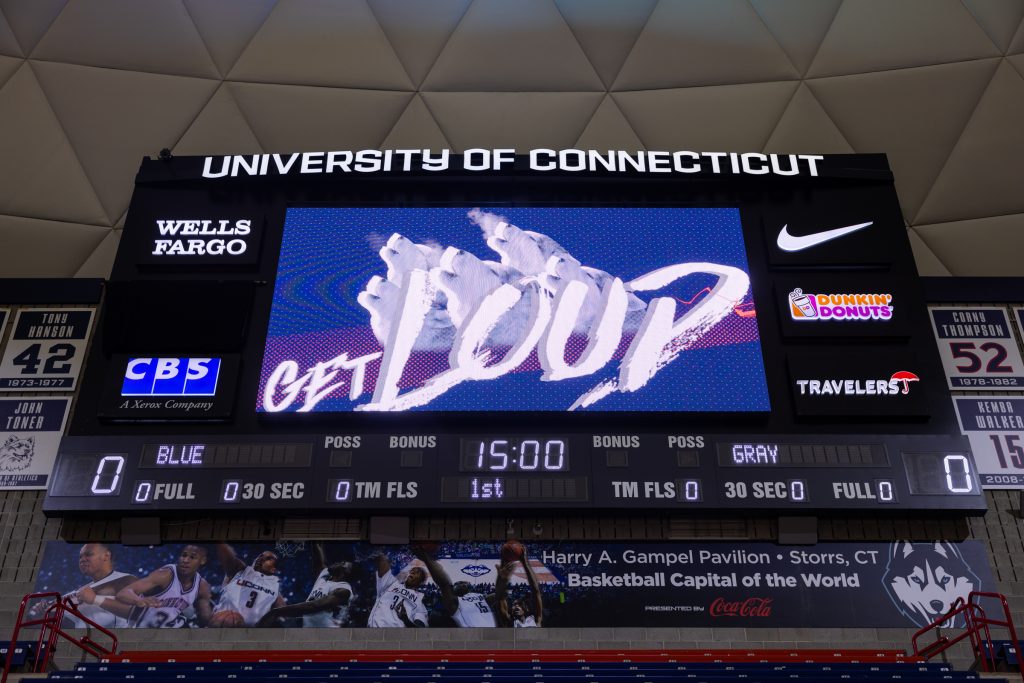
The video board in Gampel Pavilion displays graphics designed by DMD students working in Athletics. (Contributed Photo)
“I’m happy I was able to capture the team’s reaction to winning that game and record the actual live game moments, along with getting the fan experience as well. That was a test for me to see how well I could handle a high-stress environment and be trusted to do good work,” he says, adding, “It all goes back to storytelling. You want to make sure, especially when you’re documenting certain events, that you capture all the emotional moments.”
The effort benefits UConn, but there’s an eye to the long term.
“While we already have an incredible number of alumni in the industry, as word gets out that we are intentionally building a sports entertainment path within UConn Digital Media & Design, it will be exciting to see the positive impact the program will have both on the student experience and the industry as a whole,” Elliott-Famularo says. “By providing an experienced talent pipeline, we will support the business demand and Connecticut’s economy.”







 Jon Larsen, from Stratford, CT, was awarded an “Outstanding Achievement in Game Design” for his video game,


 Guerra, with Connecticut Congressman Jim Himes, and the production team for Grit & Grace (Contributed Photo)